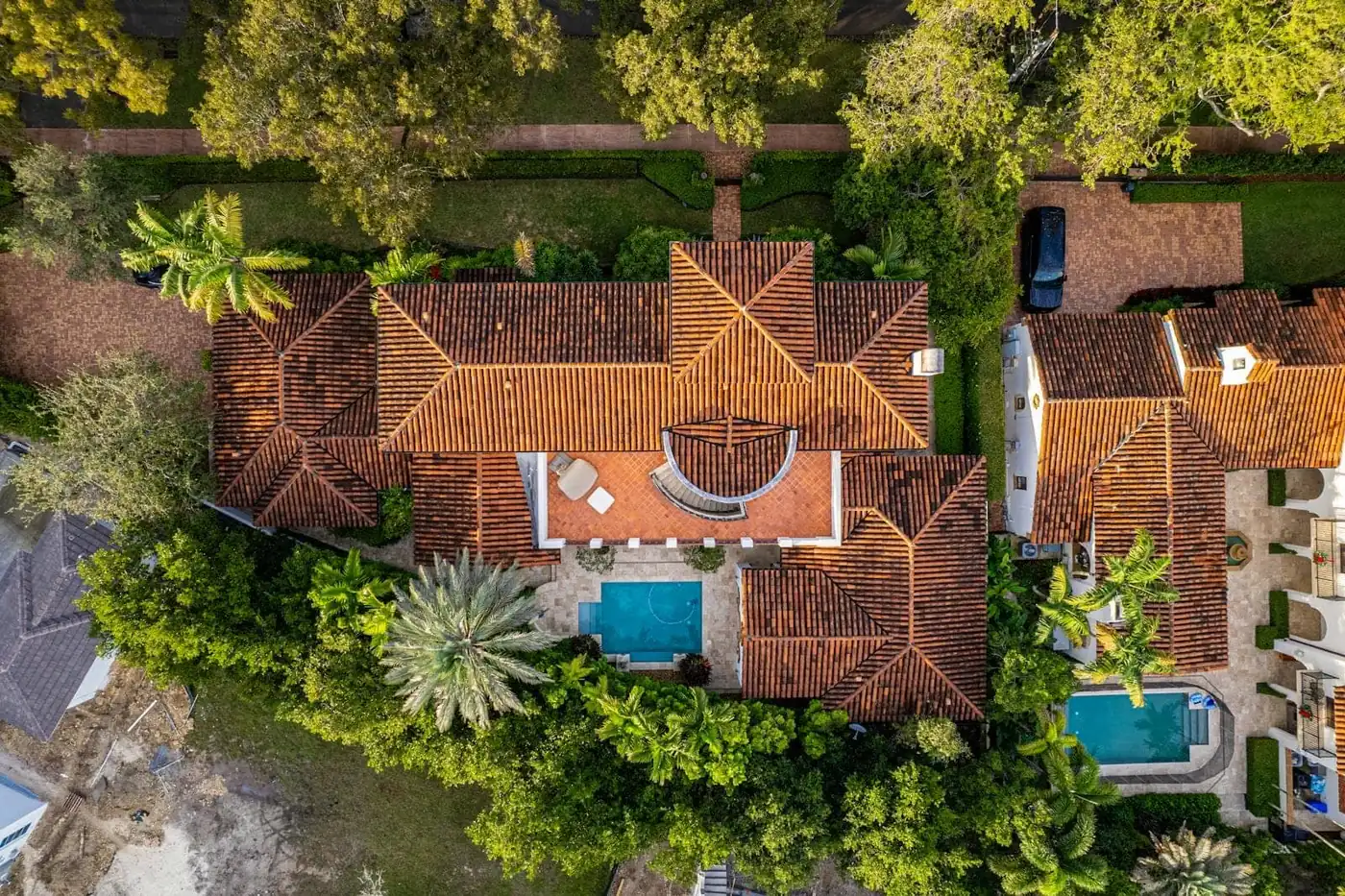
Materials & Roof Types
What roof material is best for South Florida?
Three factors: (1) Your home's architectural style — tile fits Mediterranean, metal fits modern, shingle fits anything. (2) How long you'll stay — tile and metal pay back over 20+ years; shingle is best for shorter holds or rentals. (3) Budget — shingle is cheapest upfront, metal has best lifecycle cost, tile has best resale. We give you our honest recommendation at the free inspection.
How long does each roof type last in Florida?
Asphalt shingle: 18-25 years (Florida UV cuts shingle life ~30% vs the north). Concrete or clay tile: 40-50 years (with one underlayment relay at 25-30 years). Standing-seam metal: 40-70 years. Flat TPO/PVC: 20-25 years. Florida is harder on every roof material than the rest of the country — UV, salt air, and hurricanes.
Tile vs metal — which is better for resale?
Both add significant resale value vs shingle. Tile has the heritage premium in Mediterranean-style markets (Boca, Coral Gables, Naples) — 75-85% recouped at sale per the Cost vs Value Report. Metal is rapidly catching up — 80-95% recouped — as buyers prioritize lower long-term maintenance. Shingle recoups only 60-65%.
Concrete vs clay tile — does it matter?
Both are excellent in Florida humidity. Clay is ~40% more expensive than concrete. Both last the same 40-50 years. Clay has color through the entire tile (concrete is surface-coated) and develops a richer patina over decades. Concrete colors look slightly more 'manufactured' up close. We recommend concrete for most homes; clay only for premium homes where the small color difference matters to the owner.
Spanish barrel vs flat tile vs S-tile?
Spanish barrel is the deep half-cylinder you see on Mediterranean homes. Flat tile is clean and modern, increasingly popular for new construction. S-tile is a single-piece compromise. Architectural fit drives the choice — see our [profile guide](/blog/spanish-tile-vs-flat-tile/) for details.
Still have questions about your roof?
Florida Building Code
What is FBC 2023 and how does it affect my roof?
FBC 2023 is the 8th edition of Florida Building Code, effective December 2023. Key requirements for re-roofs: sealed roof deck (R905.1.2), self-adhered underlayment, hurricane strap inspection during tear-off (R908.5), drip edge at all eaves and rakes (R903.4.1), and verified attic ventilation (R806). Every Sanctuary install meets or exceeds these. See our [code changes guide](/blog/florida-building-code-2023-roof-changes/) for details.
What is HVHZ and does my home need HVHZ-rated materials?
High Velocity Hurricane Zone — covers all of Broward and Miami-Dade Counties. HVHZ requires more stringent product testing (ASTM E1996, TAS 100/124/125) than the rest of Florida. If your home is in HVHZ, every material we install carries a Miami-Dade Notice of Acceptance (NOA). Palm Beach County is not HVHZ but most HVHZ-rated products are also approved for Palm Beach.
What is a Notice of Acceptance (NOA)?
Miami-Dade County's product approval system — basically the certification that proves a roofing product (tile, shingle, underlayment, fastener, vent) has passed the strict HVHZ testing. Every product needs its own NOA. We carry NOAs for everything we install and provide them with your warranty packet.
Do you handle the building permit?
Yes. We pull the permit at your municipality, schedule mid-roof and final inspections, and handle every interaction with the city. Permit fees are included in your quote. You don't make a single phone call to your building department.
Still have questions about your roof?
Pricing & Process
How much does a new roof cost in South Florida?
Architectural shingle on a 2,000 sq ft home: $12,000-$18,000. Concrete tile: $24,000-$40,000. Standing-seam metal: $20,000-$32,000. Flat TPO/PVC: $8-$14 per sq ft. Pricing scales with roof pitch, complexity (chimneys, dormers, valleys), and tear-off difficulty. See our [cost-of-ownership math](/blog/tile-vs-metal-vs-shingle-cost-of-ownership/) for a 30-year comparison.
Why are some quotes so much cheaper?
Almost always one of three reasons: (1) cheaper materials (3-tab vs architectural shingles), (2) no tear-off — installing over existing layer (illegal in most municipalities and voids manufacturer warranty), (3) the contractor isn't paying for workers' comp. Compare quotes line-by-line. See our [how to read a roofing quote guide](/blog/how-to-read-roofing-quote/) for the full decoder.
How long does roof installation take?
Asphalt shingle: 2-3 days for a typical 2,000 sq ft home. Concrete/clay tile: 5-8 days due to weight and detail work. Standing-seam metal: 3-5 days. Flat TPO/PVC: 1-3 days. We protect floors, work in dry weather, and tarp end-of-day if storms threaten.
How fast can you start after I sign?
Permits typically take 3-7 business days at most South Florida municipalities. Material lead time is 1-2 weeks for shingle, 2-4 weeks for tile or metal. Most projects begin installation within 2-3 weeks of contract signing.
Do you offer financing?
Yes. 0% APR for 12-24 months and extended-term plans up to 144 months through Synchrony and GreenSky. Most homeowners qualify with no money down. Application takes 5 minutes during your in-home estimate.
Still have questions about your roof?
Roof Add-Ons
What add-ons should I install while the roof is off?
Three high-ROI add-ons: (1) [Seamless aluminum gutters](/services/gutters/) — protects foundation and landscaping. (2) [Soffit and fascia replacement](/services/soffit-fascia/) — most fascia is rotted by re-roof time. (3) [Attic ventilation upgrade](/services/attic-ventilation/) — drops attic temps 30-40°F, cuts AC bills, extends roof life. Skylights and impact windows are also easier to install during a re-roof. See our [7 add-ons guide](/blog/7-add-ons-every-florida-reroof/) for full details.
Why install gutters with the roof?
Roofers are already on the eaves with ladders. New gutters coordinate with new fascia color automatically. Standalone gutter installs add a $400-$800 mobilization fee on top of the gutter cost. Bundle and save.
Are skylights safe in Florida hurricanes?
VELUX deck-mounted skylights with Miami-Dade NOA-approved laminated impact glass and engineered flashing kits are completely hurricane-safe. The leak risk comes from cheaper brands and contractors who don't follow VELUX's 10-step install protocol. We install to spec, every time.
How much will attic insulation save me?
Most South Florida homes have R-13 to R-19 insulation (older construction). Code minimum for new construction is R-30. Upgrading to R-30 with AttiCat blown-in fiberglass costs $3,000-$5,000 and saves $15-$50/month on AC bills. Payback is typically 5-8 years, then it's pure savings for the life of the home.
Still have questions about your roof?
Warranty & Maintenance
What warranty comes with my new roof?
Two warranties on every install: (1) Our 10-year workmanship warranty covering installation defects — fully transferable if you sell. (2) The manufacturer's product warranty on materials — typically 25 years for shingle, 30-50 years for tile, 30-50 years for metal, 20 years for flat. We're factory-certified for the major brands so you get their longest available coverage.
What happens if my roof leaks after install?
Call (561) 600-0933 or email info@sanctuaryhomesolutions.com. We respond within one business day and dispatch a tech within 5-7 days for non-emergency repairs (same-day for active leaks). Most warranty repairs are completed in a single visit, at no cost.
Do you offer maintenance after installation?
Yes — we offer free annual inspections for the first 3 years post-install. We check for loose flashing, blocked drains, missing tile, and any storm damage. Most issues caught early are 5-minute fixes. Ignored, they become $5,000 problems.
Is the warranty transferable when I sell?
Yes — our 10-year workmanship warranty is fully transferable to subsequent owners. Manufacturer product warranties are typically transferable once (with a small fee). Both add resale value at sale time.
Still have questions about your roof?
Insurance Claims
Will my insurance cover a new roof?
Maybe. Florida insurance has changed dramatically since 2022. Statute 627.7011 means roofs with under 25% storm damage are repaired, not replaced. Roofs older than 25 years are often denied entirely. We do free inspections and tell you honestly what's likely covered. We don't promise insurance-paid roofs as a sales tactic.
What is the 25% rule?
Florida Statute 627.7011, effective 2022: roofs with less than 25% storm damage must be repaired (not replaced) under your insurance policy. The rule was created to limit insurance fraud — but it does mean smaller damage events no longer qualify for full replacement. We assess honestly during your inspection.
Will you meet my insurance adjuster?
Yes — for legitimate storm-damage claims. We climb the roof together, point out every damage point and code requirement, and document the conversation. We do not work with public adjusters or "claim chasers" — just honest documentation of real damage.
My claim was denied. Can you help?
Sometimes. Denials happen for legitimate reasons (insufficient damage, roof too old) or contestable reasons (adjuster missed damage, scope was wrong). We can do a free second-opinion inspection and tell you whether a contested supplement is realistic.
Still have questions about your roof?

Reply within 1 business hour
Still have questions?
We answer every call within one business hour. No call center, no script — just a Florida roofer on the other end.